

About Mt Meru
Mount Meru, which is located within the Arusha National Park, overlooking Arusha town, is the second highest mountain in Tanzania after Kilimanjaro. It is an exciting mountain to climb. There are numerous animals to see on the lower slopes and vegetation zones change as you ascend.
Parts of the climb along the saddle are very steep but the views of Kilimanjaro 80km to the northeast and of the cliff face from the summit down to Meru Crater are spectacular. One does not however need technical equipment for the climb.
Mount Meru is usually scaled in 3 days / 2 nights, but since descending from summit takes about 7 hours, some climbers opt for an extra night at Miriakamba Hut which will make it a 4-day / 3 nights climb. Overnight accommodation is in alpine huts on your way up and down.
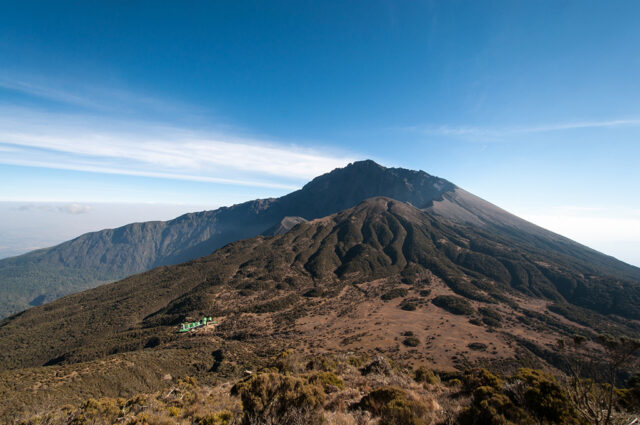
Mount Meru is considered one of the most difficult mountains to climb due to its challenging terrain, unpredictable weather, and demanding rock climbing sections. The only official route to the peak is the Momella route, which can take three to four days to reach.
MT MERU – ROUTES DESCRIPTION
Day 1: Morning transfer to Momela Gate (1500m) to start the climb, 3 hours walk gets you to Mariakamba Hut. Afternoon explore the Meru Crater. Overnight at Mariakamba Hut.
Day 2: Climb to Saddle Hut which will take about three hours along the steep Saddle walls. Explore Little Meru (3820m), a 1 ½ hour climb in the afternoon. Overnight at Saddle Hut
Day 3: Early morning ascend to the summit of Mount Meru (4566m) which will take up to 5 hours and then return to Mariakamba Hut for overnight OR descend to Momela Gate (7 hours).
Although Mt Meru is usually climbed from the western side at Olkokola, it can be climbed via Little Meru. The best time to climb the mountain is between October and February, although there may be some rain in November.
- Prepare physically: Start training at least two months before your climb. You can try long walks, swimming, and yoga. You should also practice deep breathing.
- Bring the right gear: You’ll need warm clothing, rain gear, a quality sleeping bag, a backpack, and trekking poles.
- Bring a guide and porters: Guides are mandatory and are armed for protection from the mountain’s wildlife. Porters are not mandatory but can help carry your equipment.
- Prepare for altitude: You should be physically fit and healthy, and prepared for altitude gains.
- Bring layers: You should bring layers and be prepared for the cold.
- Bring lotion and lip balm: You should also bring lotion and lip balm.
- Bring water: You should be prepared to drink water and pee often.
- Ask about sunrise: You can ask your guide if you’ll make it to the summit in time for sunrise.